Most homeowners only think about their garage door springs after they hear that loud bang on a cold morning and find the door suddenly immovable. By then the spring has already completed its final cycle. The signs of impending spring failure are almost always present weeks or months before the break, visible to a trained eye during a routine inspection but invisible to anyone who does not know what to look for. Garage door spring maintenance is one of the most overlooked services in residential home care despite springs being the single most load-bearing component in the entire system. This guide covers exactly what a professional spring maintenance visit includes, what each step is actually looking for, and why waiting until something fails always costs more than staying ahead of it.
Why Garage Door Springs Need Regular Maintenance
Standard residential torsion springs are rated for approximately 10,000 cycles, a figure established under DASMA TDS-163, the technical data sheet governing torsion spring specifications and performance standards for residential garage door systems. At four open and close cycles per day that rating translates to roughly 6.8 years of service life under normal use. Springs that receive no maintenance routinely fail before reaching that rated cycle count because metal fatigue accelerates when friction and corrosion go unchecked. In Madison, WI, where temperatures regularly drop well below freezing, that timeline compresses further. Metal contracts in cold temperatures placing additional stress on coils already under significant mechanical tension, and lubricants thicken in the cold reducing their protective ability. Proactive garage door spring maintenance is not optional in a Midwest climate. It is what allows a spring to reach its rated life rather than failing well short of it.
Visual Inspection Of The Springs And Surrounding Hardware
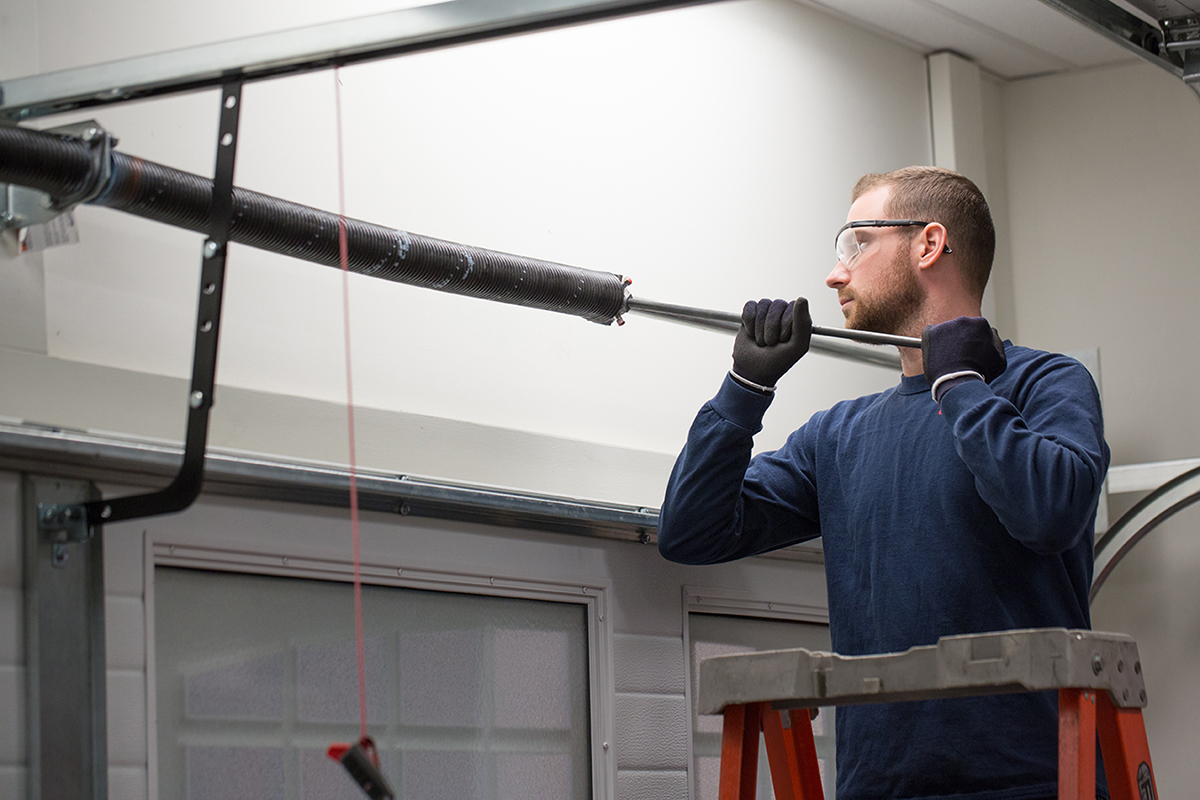
A professional spring inspection goes considerably beyond a quick visual scan. When our technicians inspect a spring they are looking for specific physical indicators that signal where the spring is in its service life and whether it is approaching a failure point.
Visible gaps in the coil are the clearest sign of a break but by the time a gap appears the spring has already failed. The more valuable findings are the subtler ones. Rust or surface corrosion weakens the metal from the outside in, accelerating fatigue without any external sign of cracking. Uneven coil spacing indicates the spring is losing its calibrated tension distribution, meaning some sections are carrying more load than others and will reach their fatigue limit ahead of the rest. Elongation at one end signals that the spring has been compensating for an unbalanced door, a condition that dramatically shortens service life. Wear marks on the torsion shaft where the spring seats indicate improper installation or gradual drift that has changed the load angle over time.
On a recent inspection our technician found a spring with noticeably tight coils on one end and slightly widened spacing on the other. That pattern told us the spring had been compensating for an unbalanced door for months and was within a few hundred cycles of failure. The homeowner had no idea anything was wrong. Without that inspection the spring would have broken during the coldest week of the year, exactly when the homeowner needed the door most.
Lubrication — What Gets Applied And Why It Matters
Lubrication is one of the most technically specific steps in a garage door spring maintenance visit and one of the most frequently done incorrectly by homeowners who attempt it themselves. Torsion springs require a lithium-based or silicone-based spray lubricant applied directly to the coils with the door in the closed position, which is when the spring is fully wound and the coils are under tension. Applying lubricant with the door open means the coils are partially separated and the lubricant cannot reach the contact points where friction actually occurs during operation.
WD-40 should never be used on garage door springs. It is a water displacement solvent, not a lubricant, and does not provide the lasting film protection that metal-to-metal contact requires during the wind and unwind cycle. WD-40 also attracts airborne debris which accumulates in the coils and accelerates the exact wear it appears to prevent. A silicone or lithium spray applied every three to six months is the correct approach, with more frequent application warranted in Madison’s climate where temperature fluctuations break down lubricants faster. During a maintenance visit the torsion shaft, cable drums, and bearing plates also receive lubrication as part of the complete spring system service.
Spring Tension Assessment And Adjustment
Spring tension assessment and adjustment is the most technically demanding and physically dangerous step in garage door spring maintenance and must be performed by a trained professional without exception. Tension is measured in IPPT, inch pounds per turn, a specification determined by the weight of the door and the number of turns wound into the spring during installation. A spring that has lost tension causes the door to feel heavy when lifted manually and forces the opener motor to carry more load than it was designed to handle, accelerating wear over time. An overtensioned spring causes the door to rise too quickly or float near the top of its travel rather than staying in position when released.
Adjusting spring tension requires inserting winding bars into the winding cone and applying precise quarter-turn increments under full spring load. A torsion spring under full tension stores enough mechanical energy to cause severe injury or death if a winding bar slips or is removed incorrectly. IDA-certified technicians, who are required by the International Door Association to demonstrate verified competency in spring installation, adjustment, and safety procedures, are the only individuals who should perform this task. No online guide can substitute for the trained hands-on experience required to safely complete a spring tension adjustment on a loaded residential spring.
Cable And Drum Inspection As Part Of Spring Maintenance
The cables and drums that work alongside your springs are always assessed during a complete garage door spring maintenance visit because their condition directly reflects the condition of the spring system they serve. A cable that is fraying or has jumped off the drum is often a symptom of a spring that has lost tension rather than a standalone cable problem. Drum groove wear indicates the cable has been running at an angle due to spring imbalance, placing lateral stress on a component that is specifically engineered to handle vertical load only and degrades rapidly when that load path changes. One of our Madison customers shared that our technician identified cable stretching during a routine maintenance visit and gave clear guidance on the timeline for service before it became a failure.
Door Balance Test — The Final Verification Step
The door balance test is the verification step that confirms whether the spring maintenance was completed correctly. Disconnect the opener by pulling the emergency release cord. Lift the door manually to approximately waist height and let go. A correctly maintained door with properly tensioned springs stays in place at that height, moving no more than one to two inches in either direction. A door that drops indicates undertensioned springs. A door that rises indicates overtensioned springs. This test takes under sixty seconds and tells us more about the functional condition of the spring system than any visual inspection alone because it tests the spring under the actual load it was calibrated to carry. It is homeowner-safe and should be performed every few months between professional maintenance visits as an early warning check that requires no tools and no technical knowledge.
How Often Should Garage Door Spring Maintenance Be Scheduled
For the average household using the garage door four to five times per day, professional garage door spring maintenance should be scheduled at least once a year. Households with heavier use or older springs benefit from a service every six months. In climates like Madison where freeze-thaw cycles and sub-zero temperatures place additional stress on metal components, the twice-yearly schedule is the more protective choice. Between professional visits, the balance test, a visual scan for rust or coil irregularities, and lubrication every three to six months with the correct product are the homeowner-appropriate steps that support the spring’s ability to reach its full 10,000-cycle rated life.
What Twins Garage Doors Includes In Every Spring Maintenance Visit
Every garage door spring maintenance visit from Twins Garage Doors includes a full visual inspection of the springs, cables, drums, and surrounding hardware, lubrication of all moving components with the correct products, spring tension assessment and adjustment by an IDA-certified technician, a door balance test to verify correct operation, and an honest assessment of remaining spring life with no pressure to replace parts prematurely because our goal is to earn your long-term trust not your immediate transaction. Our technicians are background-checked, continuously trained to the latest IDA standards, and available same-day so spring maintenance never has to wait until a failure forces the issue. Every visit is backed by warranty coverage on both labor and parts.
Ready To Schedule Your Garage Door Spring Maintenance?
Proactive garage door spring maintenance is always less expensive than the emergency repair that follows a spring failure, and in most cases it is the difference between a scheduled service visit and a same-day emergency call on the worst morning of the year. Get a free quote on our website and let an IDA-certified technician assess your spring system before the next cold morning makes the decision for you and your family.